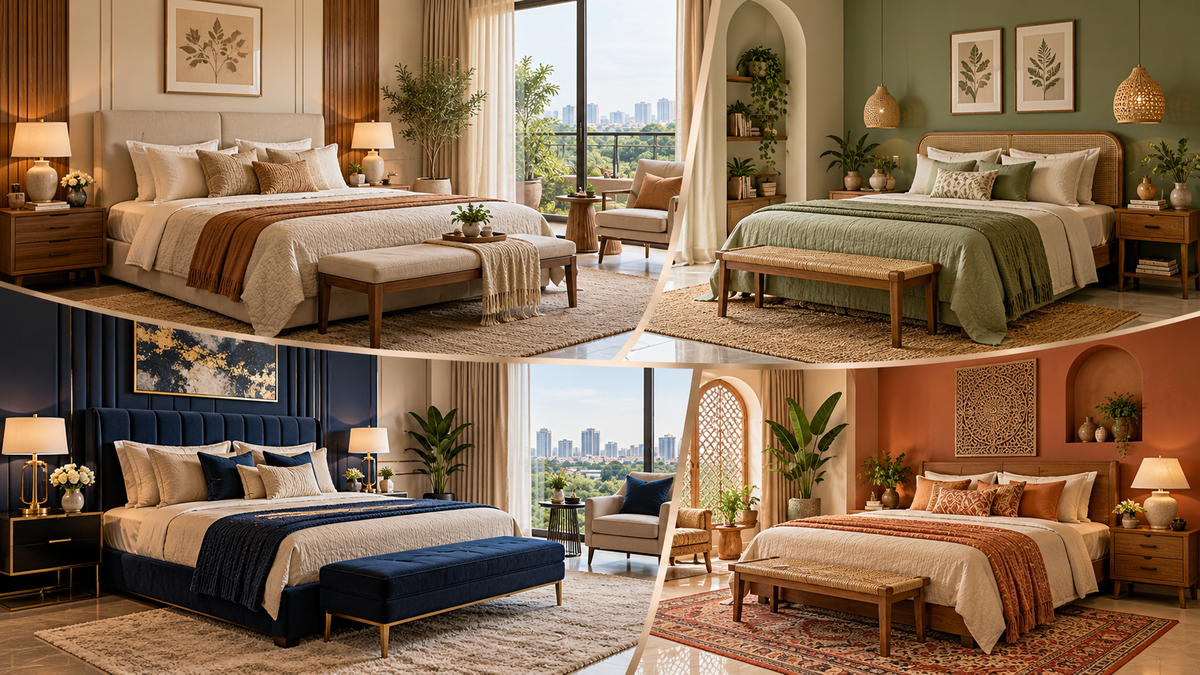
The best bedroom colour combinations for Indian homes include cream and beige, sage green and white, navy blue and beige, terracotta and cream, and light grey and white. For small bedrooms, lighter shades usually create a brighter appearance. For master bedrooms, deeper colours such as forest green, charcoal and navy blue work well as accent walls when paired with neutral furniture.
Choosing the right bedroom colour combination also depends on your bed frame, wardrobe, flooring and natural light. A dark wooden bed may look better against cream walls, while white wardrobes can be paired with sage green, lavender or powder blue.
This guide covers 25 bedroom colour combinations, matching furniture ideas and practical recommendations for different bedroom sizes and interior styles.
Which Bedroom Colour Combination Is Best for Your Home?
The right combination depends on how your bedroom is used and the furniture already in place.
|
Bedroom requirement |
Best colour combination |
Matching furniture |
|
Small bedroom |
Cream and beige |
Light oak bed, cream wardrobe |
|
Modern master bedroom |
Navy blue and beige |
Beige upholstered bed, walnut tables |
|
Luxury bedroom |
Forest green and ivory |
Ivory bed, dark walnut furniture |
|
Bedroom with little daylight |
Warm white and sand |
Light wooden furniture |
|
Bedroom with wooden furniture |
Sage green and cream |
Oak or walnut bed |
|
Traditional Indian bedroom |
Terracotta and cream |
Teak-finish furniture |
|
Minimal bedroom |
White and light grey |
Grey upholstered bed |
|
Contemporary luxury bedroom |
Charcoal and warm white |
Beige bed, black metal accents |
Quick recommendation: If you are unsure where to begin, cream and beige are flexible choices because they work with most wood finishes and neutral upholstery colours.
How to Choose a Bedroom Colour Combination That Matches Your Furniture
Consider the Size of Your Bedroom
For smaller bedrooms, try cream, warm white, powder blue, pale grey or mint green. These lighter shades generally reflect more light and can make the room appear less enclosed.
A larger bedroom gives you more flexibility to use forest green, charcoal, navy blue or burgundy. However, darker colours still need to be balanced with lighter furniture, bedding and adequate lighting.
Match Wall Colours with Existing Furniture
If your bedroom already has a dark walnut wardrobe, cream, muted green or beige walls can provide contrast.
For white furniture, consider lavender, powder blue, sage green or blush pink. Natural oak beds work well with warm neutrals and earthy colours.
Consider Natural Light and Window Direction
A room with limited daylight will generally benefit from lighter walls and reflective surfaces.
Rooms receiving strong afternoon sunlight may benefit visually from muted colours, although the perceived effect of any paint shade depends on its undertone and the light entering the room.
Test samples in both daylight and artificial light before committing to the final combination.
25 Best Bedroom Colour Combinations with Matching Furniture Ideas
1. Cream and Beige Bedroom Colour Combination

Cream and beige create a warm, neutral bedroom that is easy to coordinate with different furniture finishes. Use cream across the main walls and beige behind the headboard for subtle contrast.
Matching furniture: Light oak bed, beige upholstered headboard, cream wardrobe and wooden bedside tables.
Best suited for: Small bedrooms, modern apartments and neutral interiors.
Design tip: Add darker wooden bedside tables if the room needs more contrast.
2. White and Light Grey Bedroom Colour Combination

White and light grey give a bedroom a simple, contemporary appearance. White keeps the space bright while grey introduces contrast without overwhelming the room.
Matching furniture: Grey upholstered bed, white wardrobe and black bedside lamps.
Best suited for: Modern bedrooms and compact apartments.
Design tip: Choose a warmer grey if the room receives limited natural light.
3. Ivory and Taupe Bedroom Colour Combination

Ivory and taupe work well when you want a neutral bedroom with more depth than plain white.
Matching furniture: Taupe upholstered bed, walnut bedside tables and ivory wardrobe with bronze handles.
Best suited for: Master bedrooms and understated luxury interiors.
Design tip: Use ivory on larger wall surfaces and taupe behind the bed.
4. Sand and Warm White Bedroom Colour Combination

Sand and warm white create a natural-looking bedroom that pairs particularly well with wood, cane and linen.
Matching furniture: Natural wood bed, cane bedside table and warm white wardrobe.
Best suited for: Minimal bedrooms and compact Indian homes.
Design tip: Choose cotton or linen curtains in off-white or beige to keep the palette consistent.
5. Greige and Off-White Bedroom Colour Combination

Greige combines elements of grey and beige, making it a flexible choice for bedrooms with both modern and wooden furniture.
Matching furniture: Beige upholstered bed, walnut wardrobe and dark metal lamps.
Best suited for: Contemporary bedrooms.
Design tip: Use a slightly deeper greige behind the headboard for definition.
6. Sage Green and Cream Bedroom Colour Combination

Sage green and cream are useful choices for bedrooms with wooden furniture. The muted green adds colour while cream keeps the larger wall surfaces light.
Matching furniture: Oak bed, cream upholstered headboard and pale wood wardrobe.
Best suited for: Modern bedrooms and nature-inspired interiors.
Design tip: Repeat sage green through one or two cushions rather than matching all the furnishings.
7. Olive Green and Beige Bedroom Colour Combination

Olive green has a warmer, earthier appearance than sage green. Beige helps balance the deeper colour.
Matching furniture: Walnut bed, beige headboard and natural wood bedside tables.
Best suited for: Medium-sized and larger bedrooms.
Design tip: Limit olive green to the feature wall if the room has limited daylight.
8. Mint Green and White Bedroom Colour Combination

Mint green and white create a fresh, light bedroom. This combination pairs especially well with white wardrobes and pale wooden furniture.
Matching furniture: White bed, white wardrobe and light oak bedside tables.
Best suited for: Small bedrooms and guest rooms.
Design tip: Use a muted mint shade rather than a highly saturated green.
9. Forest Green and Ivory Bedroom Colour Combination

Forest green and ivory provide a stronger contrast suited to bedrooms with good lighting.
Matching furniture: Ivory upholstered bed, dark walnut side tables and brass lighting.
Best suited for: Master bedrooms and luxury interiors.
Design tip: Keep the ceiling and remaining walls ivory to balance the darker feature wall.
10. Pistachio Green and Light Wood Bedroom Colour Combination

Pistachio green creates a soft colour scheme that pairs naturally with pale wooden furniture.
Matching furniture: Light wooden bed, cream wardrobe and white bedside tables.
Best suited for: Guest bedrooms and compact apartments.
Design tip: Use warm white on adjacent walls to prevent the room from becoming too green.
11. Sky Blue and White Bedroom Colour Combination
Sky blue and white are practical options when you want a bedroom with a light, airy appearance.
Matching furniture: White upholstered bed, white wardrobe and oak bedside tables.
Best suited for: Small bedrooms and coastal-style interiors.
Design tip: Select a muted sky blue rather than a bright shade for larger wall areas.
12. Navy Blue and Beige Bedroom Colour Combination

Navy blue creates a strong feature wall, while beige keeps the remaining bedroom surfaces warm and neutral.
Matching furniture: Beige upholstered bed, walnut bedside tables and cream wardrobe.
Best suited for: Master bedrooms and contemporary interiors.
Design tip: Use navy blue behind the bed and beige on the remaining walls.
13. Powder Blue and Light Grey Bedroom Colour Combination

Powder blue and light grey work well in bedrooms where you prefer muted, cool-toned interiors.
Matching furniture: Grey upholstered bed, white wardrobe and pale wood bedside tables.
Best suited for: Modern apartments and guest bedrooms.
Design tip: Add warm lighting and wooden details to balance the cooler shades.
14. Teal Blue and Cream Bedroom Colour Combination

Teal blue provides a deeper colour option for bedrooms without relying on black or charcoal.
Matching furniture: Cream upholstered bed, walnut bedside tables and beige wardrobe.
Best suited for: Contemporary master bedrooms.
Design tip: Use teal on one wall and cream across the remaining surfaces.
15. Dusty Blue and Warm White Bedroom Colour Combination

Dusty blue has a muted grey undertone that makes it easier to coordinate with wood and neutral upholstery.
Matching furniture: Natural wood bed, beige headboard and off-white wardrobe.
Best suited for: Minimal bedrooms.
Design tip: Pair dusty blue with warm lighting to prevent the room from appearing too cool.
16. Blush Pink and Grey Bedroom Colour Combination

Blush pink and grey create a soft modern palette. The grey balances the pink, making it suitable for adult bedrooms as well as guest rooms.
Matching furniture: Grey upholstered bed, white wardrobe and light wood bedside tables.
Best suited for: Contemporary bedrooms.
Design tip: Choose a muted blush rather than a bright pink.
17. Peach and Ivory Bedroom Colour Combination

Peach and ivory introduce warmth without using bold reds or oranges.
Matching furniture: Cream upholstered bed, light oak wardrobe and beige bedside tables.
Best suited for: Guest bedrooms and smaller master bedrooms.
Design tip: Use muted peach on the feature wall and ivory elsewhere.
18. Lavender and White Bedroom Colour Combination

Lavender and white are suitable when you want a lighter alternative to dark purple.
Matching furniture: White bed, light grey wardrobe and pale wooden bedside tables.
Best suited for: Small bedrooms and guest bedrooms.
Design tip: Select lavender with a soft grey undertone to make furniture matching easier.
19. Dusty Rose and Beige Bedroom Colour Combination

Dusty rose and beige create a warmer alternative to pink and grey.
Matching furniture: Beige upholstered bed, walnut side tables and cream wardrobe.
Best suited for: Master bedrooms and modern interiors.
Design tip: Use warm white bedding to prevent the room from becoming too monochromatic.
20. Terracotta and Cream Bedroom Colour Combination

Terracotta and cream work particularly well with the warm wood tones found in many Indian homes.
Matching furniture: Teak-finish bed, cream upholstered headboard and natural wood wardrobe.
Best suited for: Traditional and contemporary Indian bedrooms.
Design tip: Use terracotta behind the bed rather than across all walls in a compact room.
21. Mustard Yellow and Off-White Bedroom Colour Combination

Mustard yellow adds a warm accent to bedrooms with dark wooden furniture.
Matching furniture: Walnut bed, cream wardrobe and dark wooden bedside tables.
Best suited for: Traditional Indian interiors and guest bedrooms.
Design tip: Choose a muted mustard shade to avoid excessive brightness.
22. Chocolate Brown and Beige Bedroom Colour Combination

Chocolate brown and beige create a warm, layered interior when paired with lighter upholstery.
Matching furniture: Beige upholstered bed, light wood wardrobe and walnut bedside tables.
Best suited for: Larger bedrooms and classic interiors.
Design tip: Avoid combining dark brown walls with a large dark wardrobe in a small room.
23. Charcoal Grey and White Bedroom Colour Combination

Charcoal grey and white create a high-contrast bedroom with a modern appearance.
Matching furniture: Light grey upholstered bed, white wardrobe and black metal lamps.
Best suited for: Contemporary master bedrooms.
Design tip: Use charcoal on one wall and keep the ceiling white.
24. Burgundy and Champagne Bedroom Colour Combination

Burgundy and champagne offer a deeper, warmer palette for spacious bedrooms.
Matching furniture: Champagne upholstered bed, walnut side tables and cream wardrobe with brass handles.
Best suited for: Large master bedrooms and classic luxury interiors.
Design tip: Use soft lighting and neutral bedding to balance the burgundy.
25. Black and Warm White Bedroom Colour Combination

Black and warm white work well in contemporary bedrooms with sufficient lighting.
Matching furniture: Beige upholstered bed, walnut bedside tables and white wardrobe with black handles.
Best suited for: Modern luxury bedrooms.
Design tip: Limit black to an accent wall or selected details rather than using it across every surface.
Which Bedroom Wall Colour Goes Best with Your Furniture?
The colour of your existing bed and wardrobe can help narrow down the right wall palette. Matching by furniture finish is particularly useful if you are repainting the bedroom without replacing the furniture.
What Wall Colours Match a Dark Brown Wooden Bed?
Cream, ivory, sage green and muted beige are good choices for a dark brown wooden bed. These shades provide contrast against walnut or dark teak finishes.
For a bedroom with a dark wooden bed and wardrobe, cream and sage green are a useful combination because the lighter walls help balance the furniture.
What Bedroom Colours Work with White Furniture?
White furniture pairs well with powder blue, sage green, blush pink, lavender and light grey.
For a compact bedroom with a white wardrobe, powder blue and white are particularly suitable if you want a light colour scheme.
Which Wall Colours Match a Grey Upholstered Bed?
A grey upholstered bed works with warm white, blush pink, sage green and light beige.
For a modern bedroom, white and light grey are an easy option. If you want more colour, choose blush pink for the wall behind the bed.
What Bedroom Colours Match Teak Wood Furniture?
Teak-finish furniture generally complements cream, terracotta, olive green, beige and warm white.
For a traditional Indian bedroom with a teak bed, terracotta and cream can create a consistent palette without replacing the existing furniture.
Best Bedroom Colour Combinations Based on Room Size and Lighting
Bedroom size and natural light are important when deciding how to distribute colours. A palette that suits a large master bedroom may need a different arrangement in a compact apartment.
|
Bedroom condition |
Suggested combination |
Recommended application |
What to avoid |
|
10 × 10 ft bedroom |
Warm white and beige |
Beige behind the bed, white elsewhere |
Several dark feature walls |
|
10 × 12 ft bedroom |
Sage green and cream |
Sage accent wall, cream wardrobe |
Too many competing green shades |
|
12 × 14 ft bedroom |
Navy blue and beige |
Navy headboard wall, beige remaining walls |
Dark walls with inadequate lighting |
|
Room with limited daylight |
Ivory and sand |
Light shades across larger surfaces |
Cool dark grey on every wall |
|
Room with dark wardrobes |
Cream and muted green |
Cream main walls, muted green accent |
Dark brown walls beside dark wardrobes |
|
Room with white wardrobes |
Powder blue and white |
Blue feature wall, white wardrobe |
Highly saturated blue throughout |
|
Room with warm-toned flooring |
Terracotta and cream |
Terracotta accent, cream walls |
Uncoordinated cool grey furniture |
Room dimensions are illustrative design scenarios, not mandatory colour rules. Window size, ceiling height and furnishings can change the result.
How to Use Two Colours on Bedroom Wall
The simplest way to use a two colour combination for bedroom walls is to paint the wall behind the bed in a stronger colour and keep the remaining walls neutral.
For example, use navy blue behind the headboard and beige on the other three walls. This creates a defined focal point without making the entire room dark.
There are three practical ways to apply two bedroom colours.
1. One Accent Wall and Three Neutral Walls
Choose the deeper shade for the headboard wall and a lighter shade for the remaining walls.
This works well with sage green and cream, navy blue and beige, or terracotta and ivory.
2. Horizontal Two-Tone Walls
Divide the wall into two sections, with a darker colour below and a lighter colour above.
This treatment can be useful in bedrooms with simple furniture and relatively uncluttered walls.
3. One Main Colour with Coordinated Furniture
You do not need to paint two different wall colours to create a two-colour bedroom.
For example, warm white walls with a navy upholstered headboard and matching cushions can establish a white-and-navy palette.
What Is the 60-30-10 Rule for Bedroom Colours?
The 60-30-10 rule is an interior design guideline that divides a room's visual colour scheme into three proportions: 60% dominant colour, 30% secondary colour and 10% accent colour.
|
Proportion |
Where to apply it |
Sage green bedroom example |
|
60% |
Main walls and larger surfaces |
Cream walls and wardrobe |
|
30% |
Feature wall and significant furnishings |
Sage green wall |
|
10% |
Cushions, lamps and decorative details |
Olive green and warm metallic accents |
These percentages are approximate visual proportions, not measurements of wall area.
For example, if your bedroom has cream walls, a sage green feature wall and wooden furniture, you can use small olive green accents without making the room visually crowded.
Common Bedroom Colour Combination Mistakes to Avoid
Choosing Colours Before Checking Furniture Finishes
A bedroom colour combination may look attractive in an online photograph but clash with your existing bed or wardrobe.
What to do: Compare paint samples directly with the wood, laminate or upholstery finishes in your room.
Using Dark Colours Across Every Wall
Deep green, navy blue and charcoal can look attractive, but using them on every wall may make a small bedroom feel enclosed.
What to do: Start with one darker feature wall and lighter colours elsewhere.
Ignoring Paint Undertones
Two colours described as beige can look different. Some have yellow undertones, while others appear pink, grey or brown.
What to do: Compare actual paint samples in daylight and under your bedroom lighting.
Matching Every Furniture Piece Exactly
Using the same finish for the bed, wardrobe, bedside tables and curtains can make a room appear overly uniform.
What to do: Combine complementary materials, such as walnut furniture with cream upholstery and muted green walls.
Selecting Colours Without Testing Them
Digital colour previews cannot reliably show how paint will appear in your bedroom.
What to do: Apply test patches, allow them to dry and assess them throughout the day.
How Furniversal Can Help You Coordinate Bedroom Colours and Furniture
A bedroom design works best when wall colours, furniture finishes, upholstery and lighting are selected together.
Furniversal's interior design services cover space planning, palette and material selection, bespoke furniture, and styling. This can be useful when coordinating a bedroom's wall colours with wardrobes, beds and other furniture.
The same principles also apply when furnishing the rest of your home. For example, a neutral bedroom palette can connect with warm wood and beige upholstery in the living room.
You can explore Furniversal's premium luxury sofas to coordinate living room furniture with the overall colour scheme of your home.
For homeowners planning a consistent palette across multiple rooms, coordinating the furniture finishes before choosing the final paint shades can reduce the need for later changes.
Conclusion: Which Bedroom Colour Combination Should You Choose?
For small Indian bedrooms, cream and beige, powder blue and white, or sage green and cream are practical colour combinations. For larger master bedrooms, navy blue and beige, forest green and ivory, or charcoal grey and warm white can create stronger contrast.
If you already own wooden furniture, choose wall colours that complement its finish. Light cream walls work well with dark walnut beds, while terracotta and muted green can complement warm teak furniture.
The best bedroom colour combination is not necessarily the most colourful option. It is the one that works with your room size, existing furniture, natural light and daily use.
Frequently Asked Questions About Bedroom Colour Combinations
1. What is the best bedroom colour combination for Indian homes?
Cream and beige, sage green and cream, navy blue and beige, and terracotta and ivory are versatile bedroom colour combinations for Indian homes. The best option depends on room size, furniture finishes and the amount of natural light available.
2. Which two colour combination is best for bedroom walls?
Sage green and cream work well for modern bedrooms with wooden furniture. Navy blue and beige are suitable for stronger contrast, while cream and light beige are useful choices for smaller bedrooms.
3. Which bedroom colours make a small room look bigger?
Warm white, cream, pale grey and powder blue can make a small bedroom appear brighter and more open. Light-coloured wardrobes, adequate lighting and less visual clutter can also help.
4. Which colour combination is best for a 10 × 10 bedroom?
Cream and beige, mint green and white, or powder blue and white are suitable starting points for a 10 × 10 ft bedroom. Use lighter shades across larger surfaces and avoid excessive contrast between the walls and bulky furniture.
5. What are the best modern bedroom colour combinations?
Popular modern bedroom colour combinations include sage green and cream, greige and off-white, navy blue and beige, and charcoal grey and warm white. These palettes complement simple furniture designs and neutral upholstery.
6. Which bedroom wall colour suits brown furniture?
Cream, ivory, warm white and muted green generally complement brown wooden furniture. The lighter wall colours provide contrast against dark walnut or teak finishes.
7. Which bedroom colour combination works with a white wardrobe?
Powder blue and white, sage green and cream, blush pink and grey, and lavender and white are suitable combinations for bedrooms with white wardrobes. White furniture is flexible enough to complement many muted wall colours.
8. Which bedroom colour combination looks luxurious?
Forest green and ivory, navy blue and beige, burgundy and champagne, and charcoal grey and warm white can create a luxurious appearance. Upholstery, lighting, furniture proportions and material quality also influence the final result.
9. Should a bedroom have two colours or three?
Two main colours are sufficient for most bedrooms. You can introduce a third colour through smaller accessories such as cushions, lamps or artwork. The 60-30-10 guideline can help distribute the colours.
10. Which bedroom colours go well with wooden flooring?
Cream, beige, sage green, dusty blue and warm white work well with many wooden flooring finishes. The best pairing depends on whether the floor has light oak, reddish teak or dark walnut undertones.
11. What bedroom colours work well in rooms with little natural light?
Warm white, ivory, sand and light beige are useful options because they generally reflect more light than darker shades. Combine them with light furniture and appropriate artificial lighting.
12. How do I choose bedroom wall colours without replacing my furniture?
Start by identifying the dominant finish of your bed and wardrobe. Choose complementary wall colours, then test samples beside the furniture. For example, cream and sage green can suit walnut furniture, while powder blue and white can complement white wardrobes.